
Green Climber LV600
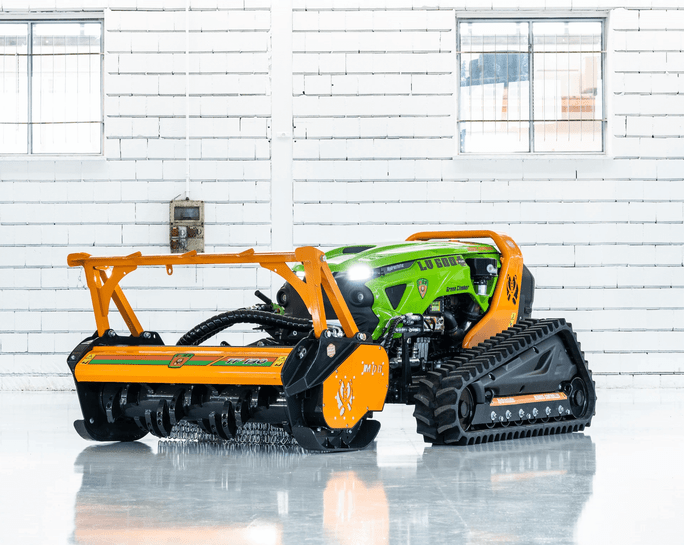
The Green Climber LV600 is a remote-controlled, tracked land-management machine designed for work where conventional equipment becomes unsafe, unstable, or damaging to the land. With a low center of gravity, adjustable track stance, and remote operation, the LV600 allows precision work on steep slopes, uneven terrain, and residential properties—while keeping the operator completely out of the hazard zone. This page exists to explain why this machine matters, how it protects land, and why we choose it instead of larger, heavier equipment.
What a Green Climber Is (and Why It Exists)
A Green Climber is not a skid steer, compact track loader, or tractor with a remote control added later. It is a purpose-built remote carrier engineered specifically for slope stability, traction, and controlled cutting in environments where operator-on-machine equipment carries unacceptable risk.
The operator never rides on the machine. That single design decision fundamentally changes how slopes, embankments, drainage corridors, and sensitive ground can be worked—safely and deliberately.
Why This Platform Works in the Real World
Remote Operation = Operator Safety
With the operator standing off the machine, work can be performed without exposing anyone to rollover zones, falling debris, or unstable footing. Visibility is improved, reaction time is improved, and safety margins are wider—especially on slopes.
Adjustable Stability on Uneven Terrain
The LV600’s tracked undercarriage can widen from approximately 54 inches to 70 inches, increasing lateral stability and spreading weight across a larger footprint when conditions demand it.
Capability Without Excess Mass
This platform delivers professional hydraulic performance without relying on sheer weight. That matters when access is tight, ground is soft, or the surrounding land is finished and valuable.
Technical Specifications (LV600 Platform)
Turbocharged diesel engine (Tier 4 Final)
~56 horsepower
~166 lb-ft of torque
Engine & Power
Designed for strong low-RPM torque so attachments maintain performance without excessive fuel use.
Maximum travel speed: ~5.5 mph
Maximum working gradient: up to ~60° (terrain-dependent)
Travel & Capability
Fuel & Fluids
Fuel capacity: ~10 gallons
Operating Weight
Base machine: ~2,850 lb
Track stance range: approximately 54" to 70"
A wider stance improves stability and weight distribution on slopes and soft ground.
Adjustable Stance
Long-range remote control (line-of-sight dependent)
Operator remains off the machine during all work
Remote Operation
Attachments & Work Tools (What We Actually Run)
Forestry Mulching Head (Carbide-Tooth Mulcher)
This forestry mulching head is designed for property owners who need dense brush, saplings, and overgrowth cleared without hauling material off-site or tearing up the ground. It uses a carbide-tooth cutting system, chosen specifically for mixed soils, rocky conditions, and real-world land where hidden debris and hard ground are common.
This is the tool we use when the question is, “How do I reclaim overgrown land without bringing in massive equipment?” It allows vegetation to be reduced in place, returning organic material to the soil while maintaining control on uneven terrain.
When vegetation becomes lighter or the goal shifts from clearing to maintenance, we transition to a flail mowing head. When material is heavy and woody, this mulching head is the correct tool—because it’s built for that level of work.
Flail Mowing Head (Heavy-Duty Y-Knife System)
This flail mowing head is used when landowners want controlled vegetation management without aggressive ground disturbance, especially on slopes, embankments, and uneven areas. It features a heavy-duty knife system with left, right, and reinforced center blades, providing strength and balance that lighter flail heads don’t offer.
This is the right tool for maintaining fields, managing regrowth, and keeping areas clean and accessible where a traditional mower or brush hog would be unsafe or imprecise. It produces a managed result while minimizing soil disruption.
When vegetation becomes too thick or woody for a flail to be effective, we step up to the forestry mulching head. Each attachment is chosen based on the condition of the land—not convenience.
Stump Grinder (FTR-400 Series)
The stump grinder is used when property owners want stumps removed below grade without excavation or major landscape damage. Using a 16-inch cutting disk, it reduces stumps precisely while preserving surrounding soil, turf, and finished areas.
This is often the preferred alternative to digging out stumps, which can leave large holes, disturb roots, and require additional repair work. Grinding allows stumps to be addressed cleanly and efficiently after clearing or mowing.
Stump grinding is selected when the goal is restoration and usability—not disruption.
4-in-1 Mini Bucket (Blue Diamond, 42")
While it functions as a standard bucket for scooping and dumping, the 4-in-1 design allows the bucket to open and close like a small grapple. This makes it especially useful for grabbing brush, debris, and irregular material during cleanup—capabilities a standard bucket does not provide.
Width: 42 inches
Capacity: ~5.6 cubic feet
Weight: ~375 lb
This attachment is manufactured by Blue Diamond Attachments
Ground Impact & Residential Suitability
Why Weight Distribution Matters More Than Access
When land clearing or forestry mulching happens near homes, lawns, septic systems, or finished yards, ground pressure matters as much as cutting power. Two machines may fit through the same gate, but still leave very different long-term yard damage depending on how their weight is distributed.
This is why “can it fit?” is the wrong question—“will it tear up my yard?” is the right one.
LV600 Ground Pressure (Measured & Calculated)
Using actual measurements from the machine:
Track width: 9.25 inches
Ground contact length: 59 inches
Total contact area: ~1,092 in²
Base machine weight: ~2,850 lb
Calculated ground pressure (dry): ≈ 2.5 PSI
Typical working pressure (with attachments): ≈ 2.7–3.1 PSI
This is real-world math—not estimates, and not marketing claims.
Worst-Case Comparison: Heavy Compact Track Loaders
High-power compact track loaders commonly used for land clearing and brush removal can exceed 13,000 lb and publish ground pressure around ~5.8 PSI in certain configurations. That’s nearly double the ground pressure applied to the soil compared to the LV600 in normal working conditions.
Higher pressure means more soil compaction, deeper ruts, and a greater chance of long-term yard damage—especially in residential settings.
What Happens When a Heavy Truck or F-450 Dually Drives on a Lawn
Most people have seen what happens when a heavy pickup or work truck—like an F-450 dually—drives across a lawn. Even a single pass can leave ruts that show up every time you mow for years afterward. Which means a pickup truck can press 20 to 30 times more pressure into soil than the Green Climber LV600.
The truck didn’t “do the work.” It just pressed weight into soft ground.
Access isn’t the problem. Pressure is.
Smart Car vs. Tracked Equipment (A Visual That Makes Sense)
For perspective, the Green Climber LV600 weighs roughly the same as a Smart car. The difference is how that weight reaches the ground. A small car concentrates its weight through four tire contact patches at typical road pressures. And still will make ruts in your lawn. The LV600 spreads similar weight across two long tracks. Barely making an impact on your Lawn.
That difference in ground pressure is why one option leaves ruts and compaction, and the other is far less likely to damage a yard.
Why We Chose the LV600 Platform
We chose the LV600 platform because land is valuable, and land clearing shouldn’t turn into a repair project. Whether the goal is a park-like setting, managed forest, controlled regrowth, or safe slope maintenance, this platform allows work to be done with far less risk to soil, turf, and surrounding property.
Instead of relying on size and brute force, the LV600 prioritizes operator safety, slope stability, and low ground impact—which matters most when work is happening near homes, finished yards, and uneven terrain.
-
Because fitting through a space is not the same as protecting the land. Heavier compact track loaders concentrate more weight into the soil, increasing the risk of rutting, soil compaction, and long-term yard damage, especially in residential and soft-ground conditions.
-
Most compact track loaders are not designed specifically for steep slope work, so manufacturers avoid publishing slope limits due to liability. Green Climber machines are engineered for slope operation, making slope capability a core, published design feature rather than an undefined gray area.
-
Yes. The LV600 delivers professional cutting and hydraulic performance while remaining lightweight and stable. Power alone doesn’t solve problems—controlled power is what allows work to be done safely on slopes and sensitive ground.
-
Any equipment can cause damage in poor conditions, but the LV600’s low ground pressure and tracked footprint significantly reduce the risk compared to heavier machines. Every site is evaluated individually to match conditions, terrain, and desired results.
-
Bigger equipment relies on mass for performance. The LV600 relies on design, balance, and purpose-built attachments. In many residential and slope environments, using a lighter, specialized platform produces better outcomes with less collateral impact.
-
Not always. Effective forestry mulching depends on matching the machine, attachment, and cutting method to the land, not simply using the largest machine available. In many cases, a purpose-built platform can do the work safely while reducing damage to the property.
-
The right equipment depends on terrain, access, soil conditions, and how much disturbance you’re willing to accept. This page explains how the machine we use performs on slopes, soft ground, and residential properties so you can understand whether it’s a good match for your land before scheduling work.
Equipment Faqs
How This Page Is Used
This page serves as a technical and trust reference. It supports research-driven decisions, reinforces land stewardship and safety, and allows service pages to remain focused on outcomes rather than equipment details. Green Climber North America